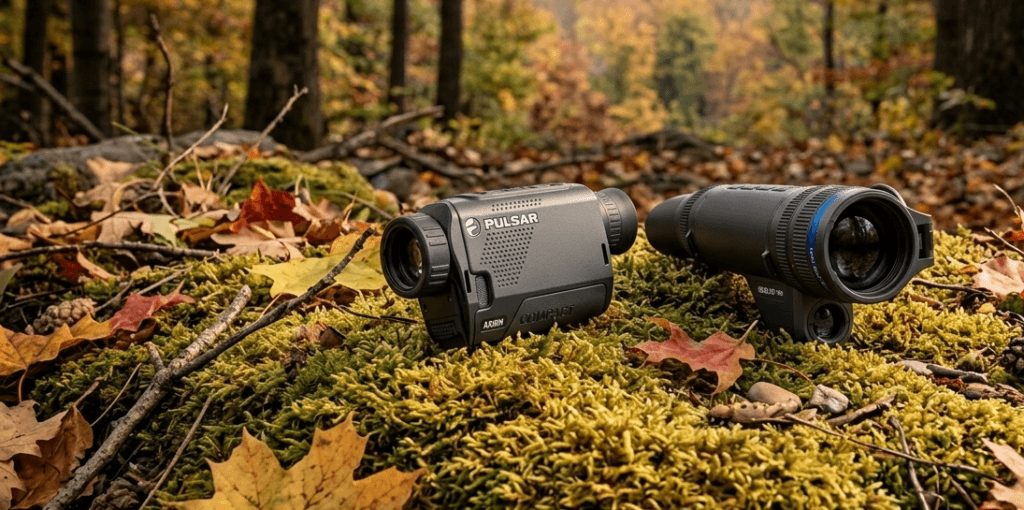
The Definitive Guide to Thermal Monoculars for Hunting: Mastering the Night with Pulsar Optics
The Thermal Revolution in the Modern Field
In my twenty years of experience within the shooting sports and outdoor optics industry, I have seen “game-changing” technologies come and go. I’ve seen the rise of digital night vision, the perfection of multi-coated glass, and the integration of laser rangefinders into everything from binoculars to riflescopes. But nothing, absolutely nothing, has shifted the tactical landscape quite like the modern thermal monocular.
Two decades ago, “night vision” was the domain of the elite military operator, consisting of heavy, green-tinted tubes that were prone to blooming and required at least some ambient moonlight to be effective. Today, we are carrying pocket-sized devices that don’t just amplify light, they see a completely different spectrum of reality. For the serious hunter, the landowner, and the tactical professional, the ability to detect heat signatures in total darkness isn’t just a luxury; it is a fundamental shift in how we interact with the environment after the sun goes down.
A thermal monocular is more than a gadget. It is a force multiplier that eliminates the “cloak of invisibility” that nocturnal predators and prey have relied on for millennia. In this guide, we’re going to dive deep into the science of infrared detection, decode the technical specifications that actually matter in the field, and look at why brands like Pulsar have become the gold standard for those who demand performance, durability, and future-proof design.

The Science of the Heat Signature: Why Thermal Beats Everything Else
To understand why you need a thermal monocular, you first have to understand what it’s actually doing. Unlike a traditional camera or your eyes, which rely on reflected light (photons), a thermal sensor, officially known as a microbolometer, detects infrared radiation (heat energy).
Infrared vs. Visible Light
Everything in the known universe with a temperature above absolute zero emits some level of infrared radiation. Living creatures, running engines, and even sun baked rocks emit significantly more radiation than the cool night air. The thermal monocular captures this energy, processes it through a sophisticated algorithm, and presents it as a visual image where ‘hot’ objects stand out in stark contrast against their surroundings.
Thermal vs. Traditional Night Vision (I2)
This is the most common question I get from people new to this technology: “Should I buy night vision or thermal?” The answer is simple: Night vision is for recognition; Thermal is for detection.
Traditional Image Intensification (I2) night vision amplifies existing light. If you are under a dense forest canopy on a moonless night, I2 night vision will fail you unless you use an infrared (IR) illuminator. The problem is that an IR illuminator acts like a beacon to anything else with night vision, and it can reflect off brush, blinding you. Furthermore, an animal standing still in a thicket is often perfectly camouflaged in a green-on-green night vision image.
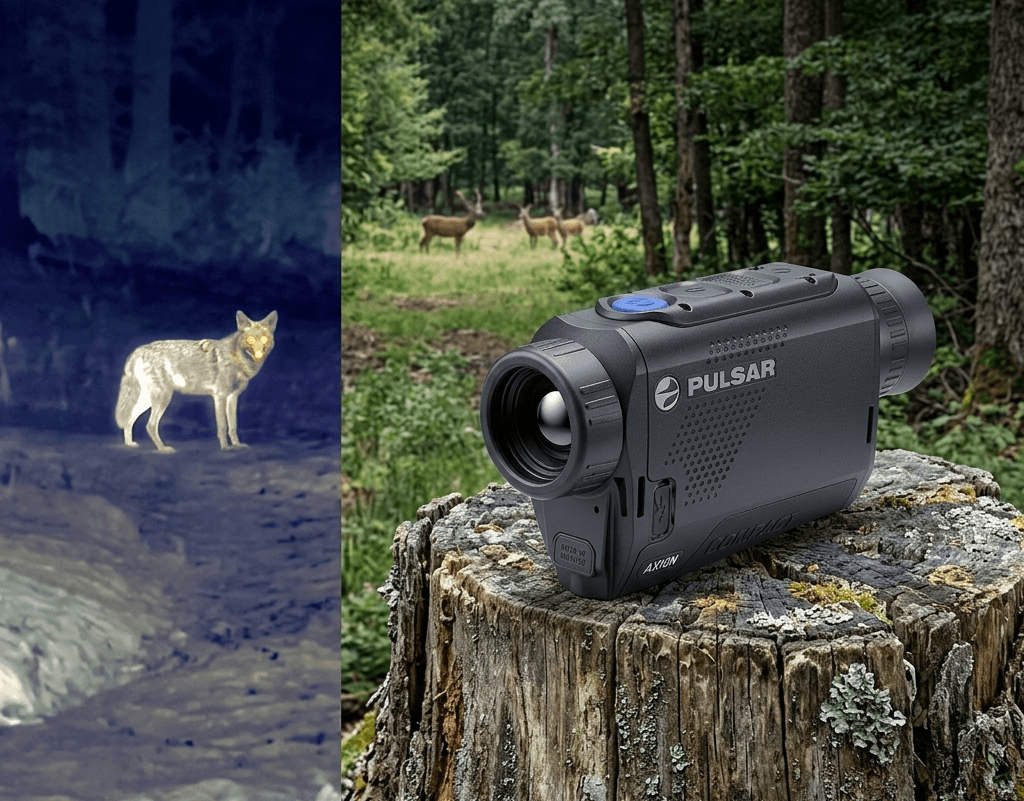
Thermal is entirely passive. It emits nothing. It sees through light fog, smoke, and thin foliage, obstacles that would completely stop a night vision device. Because an animal’s body temperature is typically 20 to 40 degrees different from its environment, it “glows” in a thermal optic. You don’t have to look for the shape of a coyote; you just look for the white-hot “flare” of its heat signature.
Decoding the Spec Sheet: Technical Factors That Dictate Performance
When you look at a Pulsar spec sheet, you’ll see a wall of numbers. If you don’t know what they mean, you’re just guessing. Here are the four pillars of thermal performance.
1. Sensor Resolution and Pixel Pitch
Resolution (e.g., 384×288 or 640×480) refers to the number of sensing pixels on the microbolometer. A 640×480 sensor has roughly 307,000 pixels, whereas a 384×288 sensor has only 110,000. Higher resolution doesn’t just mean a “prettier” image; it means you can use digital zoom without the image becoming a blocky, pixelated mess. It also provides a wider field of view, allowing you to scan more ground in a single pass.
Pixel Pitch (measured in microns, µm) is the distance between the centers of the pixels. The industry standard has moved from 17µm down to 12µm. A smaller pixel pitch allows the manufacturer to use a smaller, more efficient sensor that can produce higher magnification levels with smaller lenses.
2. NETD: The Sensitivity Benchmark
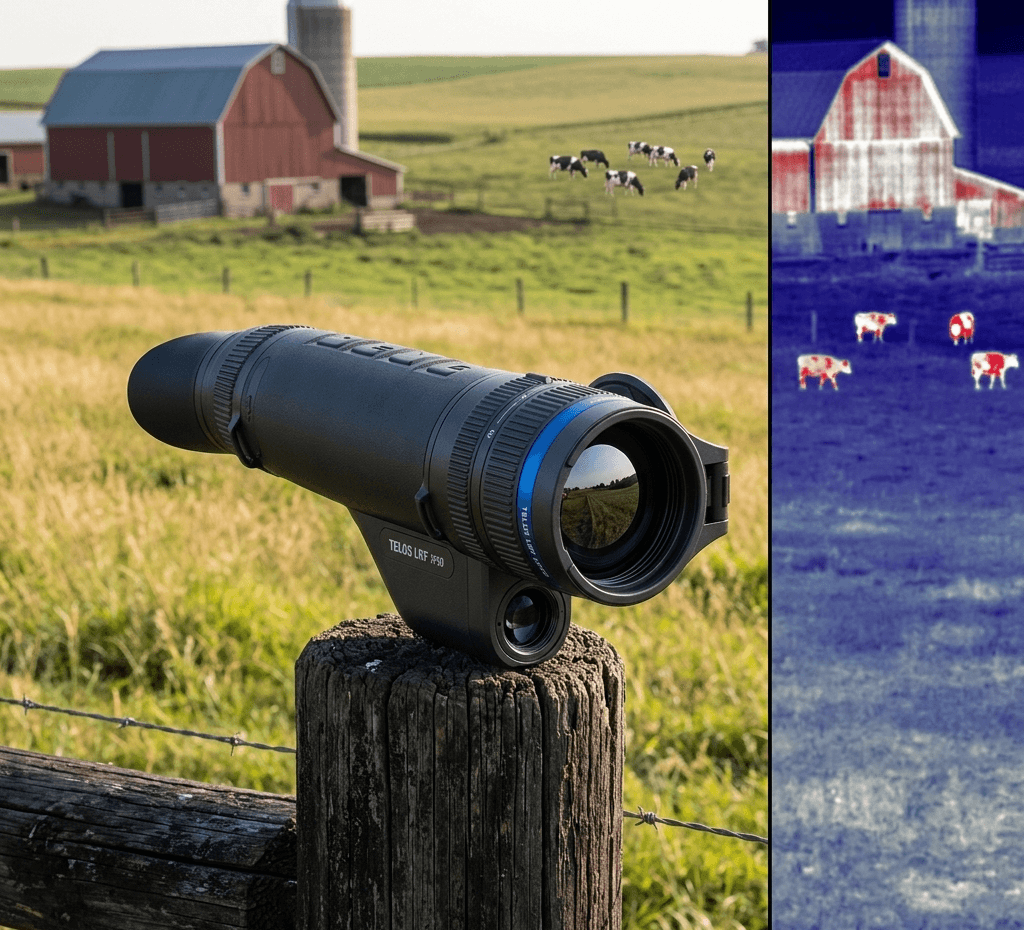
NETD (Noise Equivalent Temperature Difference) is arguably the most important spec that most buyers ignore. It is measured in millikelvins (mK) and defines the sensor’s ability to distinguish between tiny differences in temperature.
Think of a cold, rainy night where everything; the ground, the trees, and the air, is roughly 45 degrees. A low-quality sensor will show you a gray “soup” with no detail. A high-sensitivity sensor with an NETD of <25mK (the gold standard found in Pulsar’s top-tier units) will still show you the texture of the tree bark, the ripples in the grass, and the faint heat coming off the animal’s hooves. Lower is always better.
3. The Germanium Lens
You cannot use standard glass for thermal optics because glass blocks infrared radiation. Instead, manufacturers use Germanium; a rare, metallic element that is transparent to the infrared spectrum. The “F-number” of the lens (e.g., F1.0 vs F1.2) determines its aperture. An F1.0 lens lets in significantly more heat energy than an F1.2, resulting in a cleaner image.
4. Refresh Rate (Hz)
If you are tracking a running hog or a trotting coyote, you need a high refresh rate. A 30Hz unit will look “laggy”, making it difficult to follow motion. Modern professional units like those from Pulsar use a 50Hz refresh rate, providing smooth, real-time motion that feels natural to the eye. Although, their are systems which offer 60Hz refresh rates, which provide an even better visual image of an animal on the move.
Pulsar: Why Professionals Choose the Blue and White
There are many entrants in the thermal market today, but Pulsar remains the benchmark for a reason. They don’t just sell electronics; they build field-ready tools designed for the rigors of the hunt.
The Pulsar Telos Series: The World’s First Upgradable Thermal
The Telos series represents a revolutionary idea in the industry: modularity. In a world where digital technology becomes obsolete every three to five years, Pulsar designed the Telos to be upgradable. Users can eventually swap out the sensor or the lens as technology advances, protecting their high-dollar investment. With its magnesium alloy housing and sub-25mK sensor, the Telos XP50 is currently widely considered the best handheld thermal on the market.
The Pulsar Axion Series: Power in Your Pocket
For the hunter who is hiking miles into the backcountry, weight is the enemy. The Axion series offers an incredibly compact form factor that can fit into a jacket pocket. Despite its size, Pulsar hasn’t cut corners on the tech, offering 640-resolution sensors and integrated laser rangefinders in the premium Axion models. Being able to range a coyote at 300 yards in total darkness is a game-changer for ethical shot placement.
Field Use: The Professional Tracking and Scouting Workflow
Having the gear is only half the battle. You have to know how to use it. In my experience, the biggest mistake new thermal users make is “scope scanning”. They mount a thermal scope to their rifle and use it to look for game.
The Scanning vs. Shooting Protocol
Scanning with a rifle is heavy, it’s fatiguing, and it’s a major safety issue. You should never “sweep” your muzzle across a field just to find a heat signature. The professional workflow involves a handheld monocular. You scan the horizon with your Pulsar monocular; which is light, ergonomic, and safe. To find the heat signature. Only once you have detected and identified your target do you move to the rifle for the shot. This saves your rifle’s battery and ensures that your muzzle is only pointed at your intended target.
The Ethics of Recovery
Thermal monoculars are arguably the greatest tool ever invented for game recovery. If an animal runs into a dense thicket after a hit, a thermal monocular can pick up the “glow” of the animal’s body even through thick brush. It can also detect the residual heat of a fresh blood trail on the ground or on foliage. For any ethical hunter, the ability to ensure no animal is lost in the dark is worth the price of admission alone.
Maintenance and Longevity: Protecting Your Investment
A top-tier Pulsar monocular is a significant investment. Here is how you keep it running for a decade.
Calibration and NUCing
You may hear a “click” sound when using your thermal. This is the Non-Uniformity Correction (NUC). The device is briefly closing a shutter to recalibrate the sensor and clear “ghost images” or noise. While Pulsar units have an automatic mode, seasoned pros often use “Manual NUC” to ensure the shutter doesn’t click right as they are about to identify a target.
Lens Care
Never use your t-shirt to clean a Germanium lens. Germanium is softer than standard glass and can be scratched by dust. Use a dedicated lens pen or a clean microfiber cloth with a small amount of lens cleaner. Always keep the lens cap on when you aren’t actively scanning.
Buyer’s Checklist: Finding Your Perfect Match
Before you buy, run through these points:
- Field of View vs. Magnification: If you hunt in the woods, you need a wide FOV (35mm lens). If you hunt open plains, you need distance (50mm lens).
- Battery Management: Does the unit use proprietary batteries or standard ones? Pulsar’s B-Pack system is highly reliable and easy to swap in the dark.
- Ergonomics: Can you use the buttons with gloves on? Tactile buttons are a must for winter hunts.
- US-Based Support: Thermal is complex. Ensure your brand has a domestic service center for repairs.
Conclusion: Own the Night
Information is the ultimate currency in the field. A thermal monocular from a brand like Pulsar gives you a level of situational awareness that was once the stuff of science fiction. Whether you are a professional ranch manager protecting your herd, a predator hunter looking for an edge, or a tactical professional, thermal technology is the most important tool you can own.
By investing in high-quality optics, mastering the technical nuances of your gear, and following professional field protocols, you don’t just hunt in the dark, you own it. The animals are out there. Now, you have the eyes to see them.