
Thermal Optics for Hog Hunting: What You Actually Need to Know
For hog hunting, the best thermal optic is the one matched to your terrain, typical engagement distance, and identification needs. Prioritize sensor resolution, thermal sensitivity, base magnification, field of view, battery system, durability, and controls. AGM, Pulsar, InfiRay Outdoor, and ATN all offer current thermal riflescope platforms spanning different performance and price tiers.
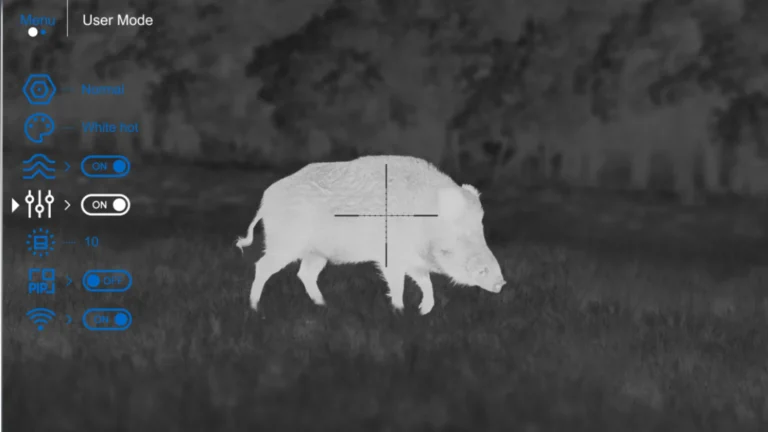
This answer intentionally avoids declaring one universal winner. Thermal-optic value changes with the hunting environment. A wide field of view and lower base magnification, can be more useful in close or mixed cover. While more optical magnification and a narrower field of view may fit open-country scanning and longer shots.
Thermal Optics for Hog Hunting: What You Actually Need to Know
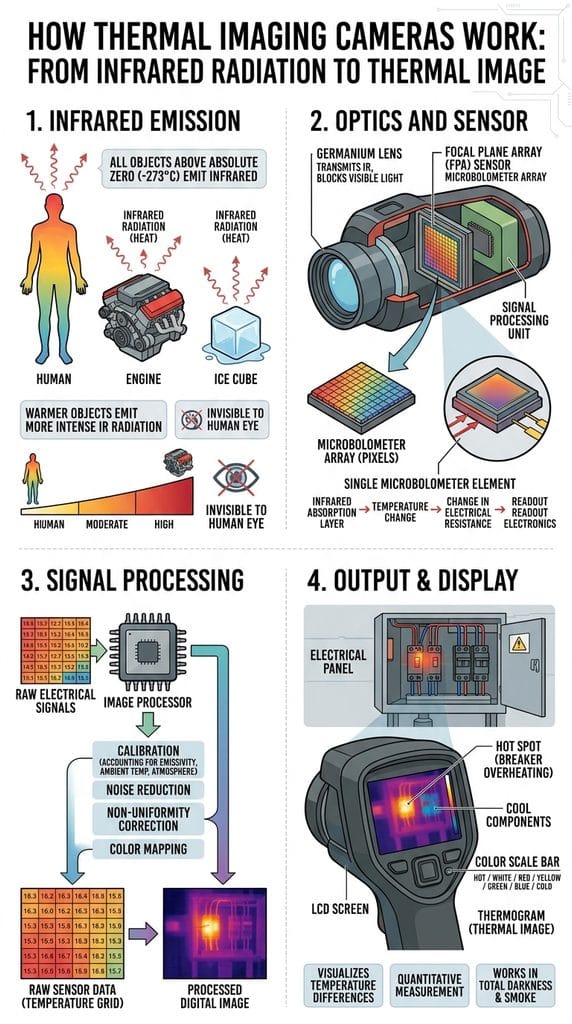
Thermal optics solve a simple but important problem. They let the user see differences in emitted infrared energy rather than relying on reflected visible light. That makes a thermal riflescope useful after dark and in other situations. Where ordinary daytime optics cannot produce a usable image. FLIR explains that thermal cameras detect infrared energy and convert it into a visible image; they are not simply low-light cameras.
Source: FLIR – How Do Thermal Cameras Work?
For hog hunters and landowners involved in nighttime predator or nuisance-animal control. However, that difference changes how you find, track, and evaluate animals in the field. Thermal imaging can reveal heat contrast quickly. But a good hunting setup still has to balance detection with identification, field of view, magnification, handling, and battery life. A specification that looks impressive by itself is not automatically the right choice for a specific property or hunting style.
How Thermal Imaging Works
A thermal optic uses a lens that focuses infrared energy onto a thermal detector. The detector and processing electronics translate differences in infrared energy into the image shown on the display. In practical terms, the optic is mapping heat contrast across the scene. Because the image is based on infrared energy rather than reflected visible light, thermal devices can operate in complete darkness.
Reference: FLIR – What Is Infrared?
That does not mean every object will appear equally clear in every environment. Image quality is affected by sensor characteristics, optics, image processing, focus, atmospheric conditions, and the amount of temperature contrast between the target and the background. This is why two optics that share the same nominal sensor resolution can still look noticeably different in real conditions.
Thermal Optics vs. Night Vision for Hog Hunting
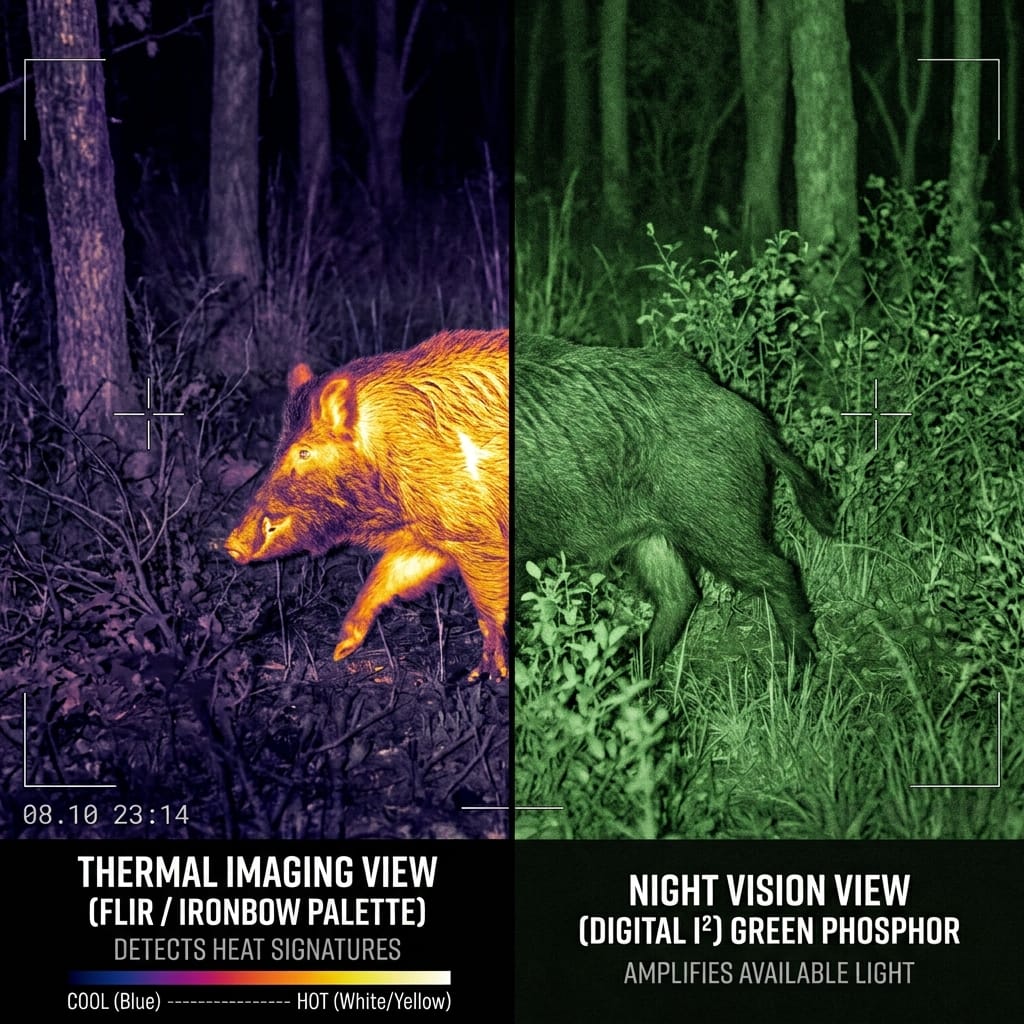
Thermal imaging and image-intensified night vision solve different problems. Thermal detects infrared energy emitted by objects and is especially effective for locating warm animals against cooler surroundings. Traditional image-intensified night vision amplifies available light and can preserve more natural scene detail. For hunting applications, many users think of thermal primarily as a detection and observation tool, while night vision can be useful when scene detail and light-based identification are the priority.
Neither technology eliminates the need for positive target identification, a safe backstop, and compliance with local hunting regulations. The optic helps you see; it does not replace sound judgment.
The Specifications That Matter Most
1. Sensor Resolution
Sensor resolution describes the number of detector elements used to build the thermal image. Current hunting optics commonly appear in 384-class and 640-class configurations, while some products move above those resolutions. More detector pixels can preserve more detail, particularly when the image is enlarged digitally, but resolution should be evaluated together with lens size, optical magnification, pixel pitch, sensitivity, and processing.
Examples from current manufacturer specifications show the range clearly. AGM lists the Rattler V3 25-384 with a 384×288 detector, while its Rattler V3 LRF 35-640 uses a 640×512 detector. Pulsar lists the Thermion 2 LRF XP50 Pro at 640×480. InfiRay USA lists several current RICO platforms at 640-class resolutions, including the RICO Mk2 LRF at 640×512. ATN’s ThOR 5 XD line lists a 1280×1024 sensor on selected models.
2. Thermal Sensitivity (NETD)
Thermal sensitivity is often expressed as NETD, or noise-equivalent temperature difference. In simple terms, it describes how small a temperature difference the detector system can distinguish under defined conditions. Lower NETD figures generally indicate greater sensitivity to subtle thermal differences, but the complete image still depends on optics, software processing, environmental conditions, and display quality.
Current manufacturer examples illustrate why this specification is worth comparing: AGM publishes sub-15 mK figures for several Rattler V3 models; Pulsar lists a sensor NETD below 25 mK for the Thermion 2 LRF XP50 Pro; and InfiRay USA lists sensitivity at or below 20 mK for the RICO Mk2 LRF.
3. Base Magnification and Field of View
This is one of the most important tradeoffs for hunters. More base magnification makes a target appear larger, but it normally reduces field of view. A wider field of view helps with scanning, tracking moving animals, and maintaining situational awareness. Higher base magnification can be advantageous in open terrain where animals are typically encountered farther away.
A useful buying rule is to start with the property rather than the specification sheet. If most shots happen inside fields bordered by brush, a relatively wide field of view may be more useful than maximum magnification. If the property has large open agricultural areas, more optical magnification can become more valuable.
4. Objective Lens and Optical System
The objective lens helps determine how infrared energy is collected and also interacts with magnification and field of view. Larger focal lengths are commonly associated with more magnification and narrower fields of view, while shorter focal lengths tend to support wider viewing angles. The right choice depends on how far you need to identify animals and how much scene awareness you want while scanning.
5. Refresh Rate
Refresh rate describes how frequently the displayed image is updated. Current hunting thermal optics frequently list 50 Hz or 60 Hz operation. Higher refresh rates can make motion appear smoother, which is helpful when scanning from a moving position or tracking moving animals. Pulsar lists 50 Hz on the Thermion 2 LRF XP50 Pro, AGM lists 50 Hz on current Rattler V3 models, and InfiRay lists 60 Hz on the RICO Mk2 LRF.
6. Detection Range Is Not Identification Range
Manufacturer detection-range figures can be useful for comparison, but they should not be treated as a promise that the user can positively identify an animal or make an ethical shot at that distance. Detection means the optic can register a target-sized heat source under a particular methodology and set of conditions. Identification depends on target size, contrast, weather, terrain, sensor and lens performance, magnification, image processing, and the user.
For this reason, use published detection range as one data point rather than the primary buying criterion. The more useful question is whether the optic gives you enough image detail and field of view at the distances where you actually hunt.
7. Battery System and Runtime
Night hunts often last longer than the action itself. Battery architecture therefore matters as much as advertised runtime. Consider whether batteries are proprietary or common, whether they are removable in the field, whether an external USB power source is supported, and whether you can swap a pack without removing the optic.
Manufacturer specifications vary. AGM lists up to seven hours for the Rattler V3 25-384 and up to 5.5 hours for the Rattler V3 LRF 35-640. Pulsar lists approximately ten hours for certain Thermion 2 Pro configurations under specified conditions, noting that actual runtime depends on feature use. InfiRay lists six-plus hours on several RICO platforms. These numbers are not directly interchangeable because test conditions and feature usage differ.
8. Durability, Weather Resistance, and Mounting
A thermal riflescope lives on a firearm and is exposed to recoil, dust, moisture, cold, heat, vehicle travel, and repeated mounting pressure. Look for a clearly published recoil rating or firearm compatibility statement, a defined ingress-protection rating where available, and a mounting system appropriate for your rifle.
Examples: AGM publishes IP67 protection on current Rattler V3 models; Pulsar publishes IPX7 on the Thermion 2 Pro specification page; InfiRay USA publishes recoil and ingress-protection information on several RICO products. Compare the exact model you plan to buy rather than assuming an entire brand uses the same rating.
9. Recording, Wi‑Fi, Rangefinding, and Ballistic Features
Digital features matter when they solve a real field problem. Onboard recording can document hunts and help review shot placement. Wi‑Fi can simplify media transfer or remote viewing. Integrated laser rangefinding can reduce the need to move between devices. Some optics also include ballistic tools, multiple zero profiles, picture-in-picture, and selectable color palettes.
These features add convenience, but they should not distract from core image quality, reliability, controls, and ergonomics. A thermal scope that is difficult to focus or operate with gloves can be less useful in the field than a simpler optic with an intuitive interface.
What Makes a Thermal Optic Good for Hog Hunting?
Hog hunting places several demands on a thermal optic at once. Animals may appear in groups, move quickly, enter from brush lines, or cross open ground. The user may spend long periods scanning and only a short period making a shooting decision. That favors an optic that produces a clear image quickly, focuses easily, offers enough field of view to follow movement, and has controls that can be operated without looking away from the scene.
The best configuration is therefore use-case specific. A compact 384-class scope can be a practical fit for shorter- to medium-range hunting and budget-conscious setups. A 640-class scope can provide more image detail and more flexibility when using digital magnification. Higher-resolution platforms can push detail further, but cost, weight, battery consumption, and optical design still matter.
How Leading Thermal-Optics Platforms Differ
The original metadata brief highlighted AGM Global Vision, Pulsar, and InfiRay Outdoor. Those brands remain useful examples because each offers multiple thermal-riflescope configurations rather than a single one-size-fits-all model. To keep this landing page brand-neutral, ATN is also included as another established thermal-optics manufacturer. The table below is not a ranking; it shows how current platforms differ.
| Example Platform | Sensor | Refresh | Notable Field Feature | Best Fit to Evaluate |
| AGM Rattler V3 family | 384×288 to 640×512 on cited models | 50 Hz | Compact formats; LRF variants available | Hunters comparing compact scope value and integrated rangefinding |
| Pulsar Thermion 2 / LRF Pro | 384×288 and 640×480 cited configurations | 50 Hz | Traditional 30 mm scope-body format; dual-battery architecture on cited models | Hunters who prefer conventional riflescope ergonomics |
| InfiRay Outdoor RICO family | 384- and 640-class options; cited Mk2 LRF is 640×512 | 60 Hz on cited Mk2 LRF | Integrated or optional LRF depending on model; high-resolution displays on selected models | Hunters prioritizing image processing and multiple form factors |
| ATN ThOR 5 XD | 1280×1024 on cited ThOR 5 XD models | 60 fps cited | Smart features, recording, ballistic tools; LRF variants | Users evaluating high-resolution smart-scope feature sets |
AGM Global Vision: Compact Hunting-Oriented Platforms
AGM’s Rattler family is a useful example of how one product line can cover multiple use cases. The current Rattler V3 25-384 is built around a 384×288 detector and 25 mm lens, while the Rattler V3 LRF 35-640 pairs a 640×512 detector with an integrated laser rangefinder. That range lets hunters choose between a more price-conscious compact optic and a higher-detail LRF-equipped configuration without treating one specification as universally superior.
Official sources: AGM Rattler V3 25-384 | AGM Rattler V3 LRF 35-640
Pulsar: Conventional Riflescope Ergonomics with Thermal Electronics
Pulsar’s Thermion family uses a familiar riflescope-style body, which can appeal to hunters who want a thermal optic that mounts and handles more like traditional glass. The Thermion 2 LRF XP50 Pro specification lists a 640×480 detector, 50 Hz refresh rate, 2–16× magnification range, and integrated laser rangefinder. The broader Thermion 2 Pro line also includes lower-resolution configurations, giving buyers several ways to trade field of view, magnification, image detail, and cost.
Official source: Pulsar Thermion 2 LRF XP50 Pro specifications
InfiRay Outdoor: Multiple Form Factors and Image-Processing Options
InfiRay Outdoor’s RICO family includes conventional weapon sights, compact multi-purpose devices, and LRF-equipped models. The current RICO Mk2 LRF is listed with a 640×512 detector, 12 μm pixel pitch, 60 Hz refresh rate, 3× optical magnification, onboard recording, and an integrated rangefinder. The RICO MICRO V2 shows a different direction: a compact multi-purpose form factor that can serve as a handheld thermal or weapon sight depending on configuration and accessories.
Official sources: InfiRay Outdoor RICO Mk2 LRF | InfiRay Outdoor RICO MICRO V2 640
ATN: High-Resolution Smart-Scope Features
ATN’s ThOR 5 XD illustrates the smart-scope end of the category. Current specifications for the 2–20× ThOR 5 XD list a 1280×1024 sensor, video recording, wireless connectivity, multiple reticle functions, and an optional LRF-equipped variant. That combination can appeal to users who value integrated digital tools, but it also reinforces an important buying point: more features only add value when they match the way you actually hunt.
Official source: ATN ThOR 5 XD 2-20x
How to Choose the Right Thermal Scope for Your Property
Start by describing your actual hunting environment before looking at brands. A useful selection process is to work through range, terrain, target identification needs, rifle setup, and expected hunt duration.
Dense cover or short fields: Prioritize field of view, manageable base magnification, fast focus, compact size, and simple controls.
Mixed terrain: Look for a balanced optic that maintains usable field of view while offering enough native magnification for field edges and open lanes.
Open agricultural ground: Higher optical magnification, a suitable objective lens, strong image detail, and rangefinding can become more important.
Long observation sessions: Weight, battery architecture, eye relief, display comfort, and easy access to controls matter more than they do on a specification sheet.
Multiple rifles or changing setups: Consider mounting repeatability, zero profiles, form factor, and how easily the optic can be removed or transferred.
Common Thermal-Optics Buying Mistakes
Buying on detection range alone: Detection is not the same as positive identification or practical shooting distance.
Assuming more digital zoom equals more detail: Digital magnification enlarges the displayed image; it does not create sensor detail that was never captured.
Ignoring base magnification: An optic can have excellent resolution and still feel too tight if its native magnification is poorly matched to the property.
Comparing NETD without context: Sensitivity matters, but lens quality, algorithms, focus, weather, and display processing also influence the image you see.
Treating every model from a brand as equivalent: Sensor, lens, display, runtime, protection rating, and rangefinder options can vary substantially inside the same product family.
Overlooking controls and ergonomics: Button layout, focus placement, eye relief, startup time, and battery swaps can determine how quickly you can react in the field.
Conclusion: Buy for the Hunt, Not the Spec Sheet
Thermal optics have matured into a broad category with meaningful differences in sensor resolution, sensitivity, magnification, field of view, battery systems, displays, range-finding, recording, and form factor. AGM, Pulsar, InfiRay Outdoor, ATN, and other manufacturers approach those tradeoffs differently. That is good for the buyer, because the right thermal riflescope does not have to be the model with the longest specification list.
Start with the terrain and the distances you actually hunt. Decide how much field of view you need, how much native magnification is practical, and how much image detail you need for confident identification. Then compare current models using published manufacturer specifications and independent field evaluation. That process is more reliable than buying on a single headline number.
Thermal Optics FAQ
AFFILIATE DISCLAIMER
Some of the links on this page are affiliate links. This means we may earn a commission at no additional cost to you if you make a purchase. This helps support our content and allows us to continue providing in-depth reviews and guides.