Thermal sensitivity explained: millikelvins, low-contrast image quality, sensor versus system NETD, and what hunters should actually compare.
Overview: What Is NETD?
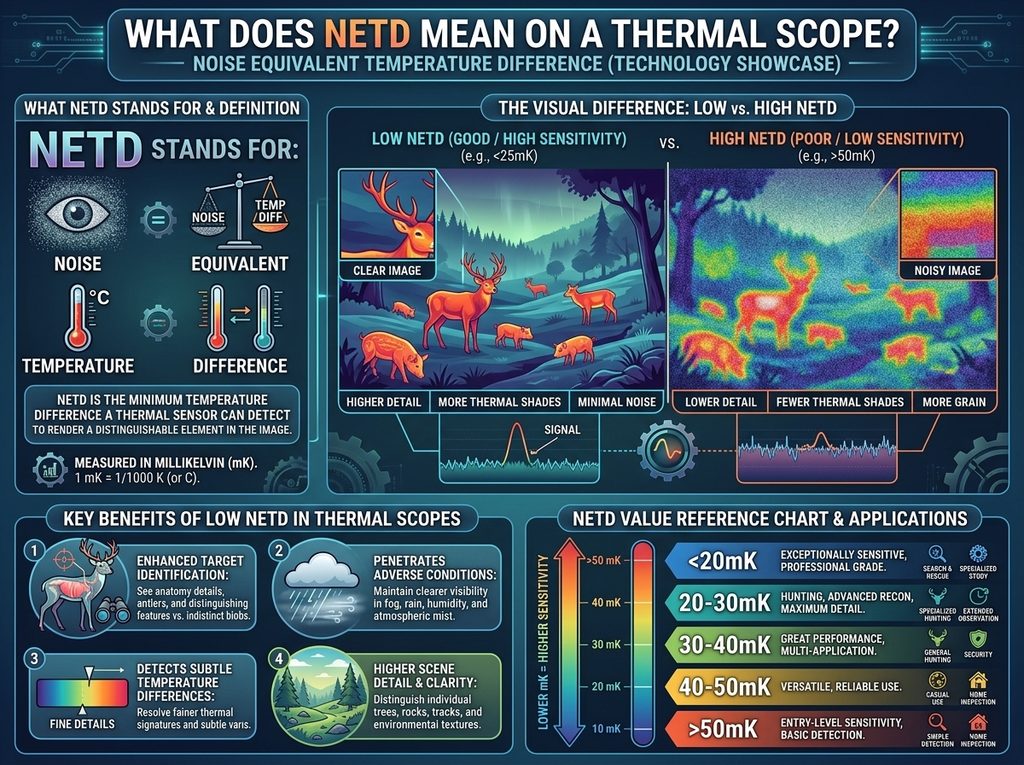
What does NETD mean on a Thermal Scope? NETD stands for noise-equivalent temperature difference. It is a thermal camera sensitivity measurement, generally expressed in millikelvins (mK), representing a temperature difference that produces a signal comparable to the system’s temporal noise under specified test conditions. Lower NETD generally means better sensitivity to subtle thermal differences, but it is not a stand alone measure of image sharpness, detection range, or real world identification capability.
Source: FLIR What is NETD Source: FLIR How NETD Is Measured
Why NETD Matters to Hunters
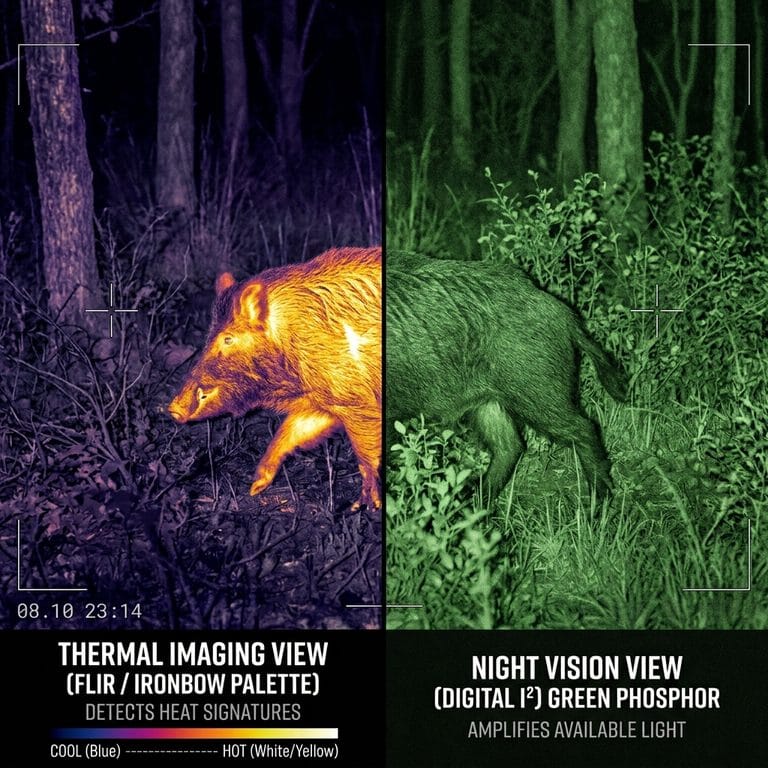
Wildlife rarely appears against a perfectly uniform, cold background. Warm soil after sunset, damp vegetation, humid air, tree trunks, and animals with partially obscured bodies can reduce scene contrast. A more sensitive thermal system may preserve tonal separation in portions of the scene where temperature differences are small. That can make the outline of an animal or a background feature easier to interpret, although results depend on the entire system.
Practical Note:
The buyer’s practical question is not simply “Which scope lists the smallest mK number?” It is “Which optic produces usable information under the temperatures, humidity, vegetation, and viewing distances where I actually observe wildlife?”
NETD Is Not Thermal Resolution
| Specification | Measures | Why it matters |
| NETD (mK) | Sensitivity relative to temporal noise | Helps distinguish small thermal differences |
| Sensor resolution (pixels) | Spatial samples available in the image | Affects how much target detail can be represented |
| Lens f-number | Optical throughput relative to geometry | Influences radiation delivered to detector |
| Focal length / field of view | How much scene is projected on the sensor | Changes target scale and search area |
| Display / processing | How captured data is presented | Influences perceived clarity and contrast |
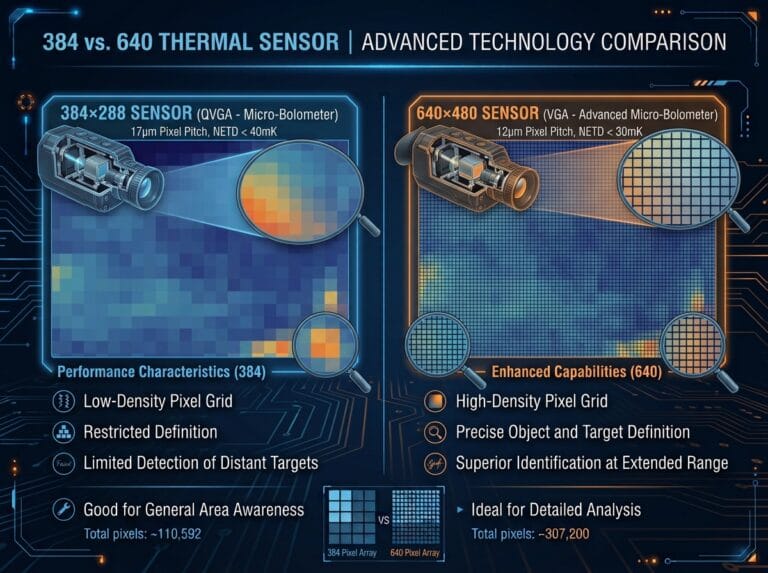
A 640-class detector is not automatically more thermally sensitive than a 384-class detector. Conversely, a 384 detector advertised at a lower NETD is not automatically a better choice for every use. Environmental detail and temperature sensitivity must be evaluated independently, then together.
How to Interpret 15 mK, 20 mK, and 25 mK
A millikelvin is one thousandth of a kelvin. Thus 15 mK corresponds to a temperature interval of 0.015 K, and 25 mK corresponds to 0.025 K. These values describe an instrument noise equivalent difference under test conditions; not a guarantee that a hunter can distinguish two animals whose temperatures differ by that amount, or that the device will identify a target at a particular distance.
For otherwise comparable, consistently measured thermal systems, 15 mK indicates lower noise equivalent temperature difference than 25 mK. In real shopping comparisons, the “otherwise comparable” qualification is critical: vendors may report sensor NETD, complete system NETD, or specifications obtained under different test conditions.
Source: FLIR What is NETD
Sensor NETD vs. System NETD
Sensor NETD characterizes detector performance in a stated configuration. System NETD reflects the complete optical electronic imaging setup under the manufacturer’s stated methodology and may incorporate optical and processing effects. These numbers should not be mixed in a simple ranking. In particular, a published system NETD can be lower than a separately stated detector figure because definitions and processing conditions are not identical.
As a concrete published example, Pulsar lists the Thermion 2 LRF XP50 Pro at sensor NETD below 25 mK and system NETD below 18 mK. It is important to label which number is being quoted rather than advertising “18 mK sensor sensitivity.”
Why Lens Speed and F-Number Affect Sensitivity
The thermal lens is part of the measurement system. Lens f-number influences the energy reaching the detector, so NETD specifications can depend on lens configuration. FLIR notes that thermal performance is often normalized to f/1.0 to improve the fairness of comparisons. Two products with different f-numbers and differently reported NETD values should not be ranked by the bare mK figure alone. [4]
Focal length and f-number answer different questions. Focal length helps determine target scale and field of view, while f-number is related to the optical system’s light collecting geometry. A larger millimeter lens is not automatically “more sensitive” unless the full optical design is considered.
Why a Low NETD Can Help in Low-Contrast Conditions
Warm, Humid Evenings
When ground, vegetation, and animal surfaces approach similar apparent temperatures, the scene may appear flatter. Better sensitivity may help distinguish small differences, though water vapor absorption and environmental conditions can still degrade the image.
Damp Grass and Vegetation
Wet surfaces and vegetation may generate subtle, rapidly changing infrared patterns. NETD can influence how cleanly small gradients appear, but emissivity, reflected radiation, calibration, focus, and processing also shape what the user sees.
Early Evening Versus Late Night
Solar heated soil, roads, and rocks may remain warm after sunset. Background cooling over time changes the apparent contrast. No single advertised NETD value predicts which hour will produce the best image.
The Limits: What NETD Does Not Tell You
- NETD does not directly state maximum detection or identification range.
- NETD does not indicate sensor resolution or native magnification.
- NETD cannot guarantee performance through dense fog, rain, or solid vegetation.
- NETD does not establish image sharpness without knowing lens quality, focus, processing, and display.
- NETD does not measure animal species recognition or positive target identification.
Published Product Examples: Read the Labels Carefully
The following examples are manufacturer published specifications, not independently standardized head-to-head laboratory measurements. Model availability and revisions can change.
| Product | Reported sensitivity | Sensor / context |
| AGM Rattler V3 LRF 35-384 | NETD <15 mK | 384 × 288; AGM specifies 25°C and f/1.0 in its manual |
| Pulsar Thermion 2 LRF XP50 Pro | Sensor <25 mK; system <18 mK | 640 × 480; 50 mm f/1.0 |
A Practical Buyer Checklist
- Identify whether each vendor’s NETD is a sensor value or a system value.
- Check whether conditions such as lens f-number, target temperature, and test method are stated.
- Compare native detector resolution, pixel pitch, focal length, field of view, and objective f-number.
- Evaluate full resolution sample footage from similar weather and terrain, not just product marketing stills.
- Assess focus control, calibration behavior, display quality, battery life, ergonomics, and warranty.
- Prefer credible independent field observations and consistent testing over an isolated headline specification.
How NETD Fits Into Detection, Recognition, and Identification
Detection asks whether a target, like heat source is present. Recognition determines its broad class, while identification requires enough information for a specific, reliable conclusion. NETD can improve sensitivity to weak contrasts; it does not create extra spatial samples across a distant target. An optic may detect a heat source yet lack the resolution and viewing conditions needed to identify it. Never treat thermal contrast as proof of identity.
Common NETD Buying Mistakes
- Calling 15 mK “15 degrees” instead of 0.015 kelvin of noise equivalent temperature difference.
- Comparing a sensor NETD to a different brand’s processed system NETD as if they were identical measurements.
- Assuming lower mK automatically means longer identification range.
- Ignoring lens f-number and the available thermal energy reaching the detector.
- Equating enhanced image processing appearance with additional underlying thermal detail.
- Treating a specification achieved under controlled conditions as guaranteed in humid or rainy terrain.
Conclusion: Buy the Whole Imaging System, Not Just the mK Number
NETD belongs on every informed thermal-optics comparison because it helps explain low-contrast sensitivity. But a purchasing decision should also include native resolution, lens design, field of view, system processing, focus, environmental limitations, ergonomics, and service support. For hunters, reliable scene interpretation and positive target identification matter more than winning a single numerical specification contest.
Frequently Asked Questions
What Does NETD Mean on a Thermal Scope?
Related Articles:
Get the Best Gear Deals & Field Insights
Stay updated with top gear recommendations, reviews, and exclusive deals.