Overview
When comparing 384 vs 640 resolution sensors, you have to consider several factors. A 640-class thermal sensor captures substantially more image samples than a 384-class sensor, which can preserve more detail and tolerate digital magnification better. But 640 is not automatically the better hunting choice: lens focal length, pixel pitch, NETD, base magnification, field of view, image processing, terrain, and budget all affect real-world performance.
Resolution Is Important, but It Is Not the Whole Image
Thermal buyers often reduce the comparison to one question: 384 or 640? The assumption is that 640 is always better. At the sensor level, a higher-resolution detector does capture more spatial information. Teledyne FLIR explains that resolution determines how much detail an imaging system can resolve, and higher resolution can improve recognition and identification performance when other system variables are comparable.
But “other variables are comparable” is the part that matters. A thermal sight is a system made up of a detector, pixel pitch, objective lens, f-number, electronics, image processing, display, focus mechanism, and magnification. Change the lens or native magnification and two scopes with different sensor resolutions can behave very differently in the field.
What 384 and 640 Mean
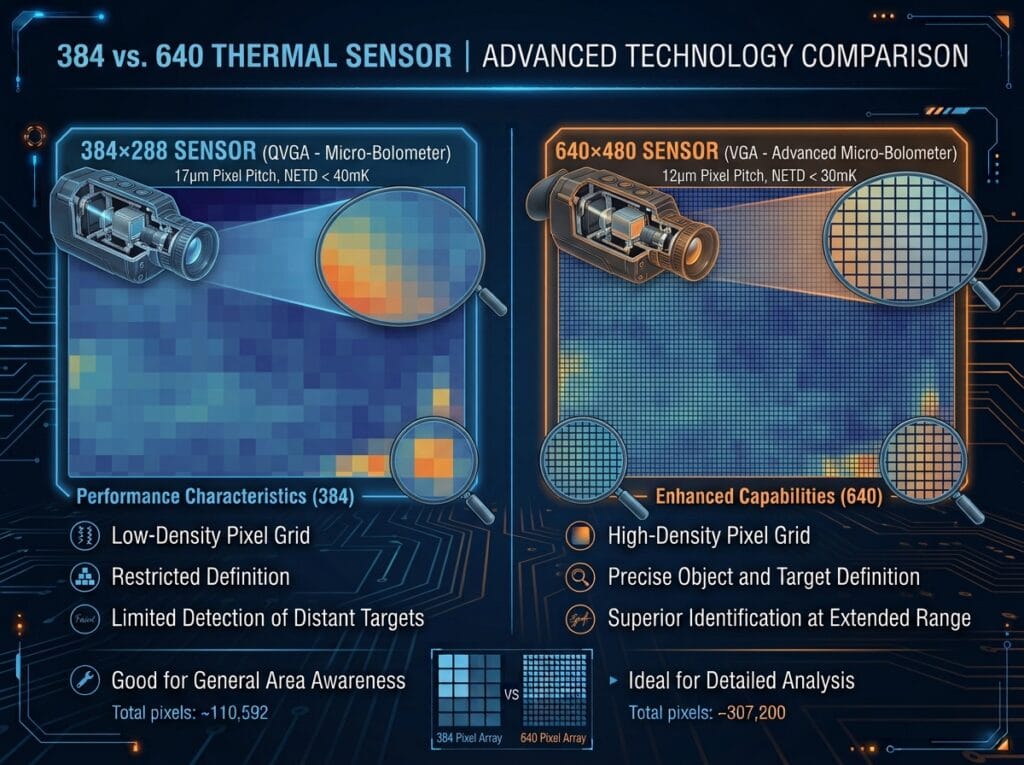
A 384×288 detector contains 110,592 detector elements. A 640×512 detector contains 327,680. That does not mean a 640 image is “three times better,” because image quality is not linear and the rest of the optical system still matters. It does mean a 640-class detector can sample the scene with many more pixels.
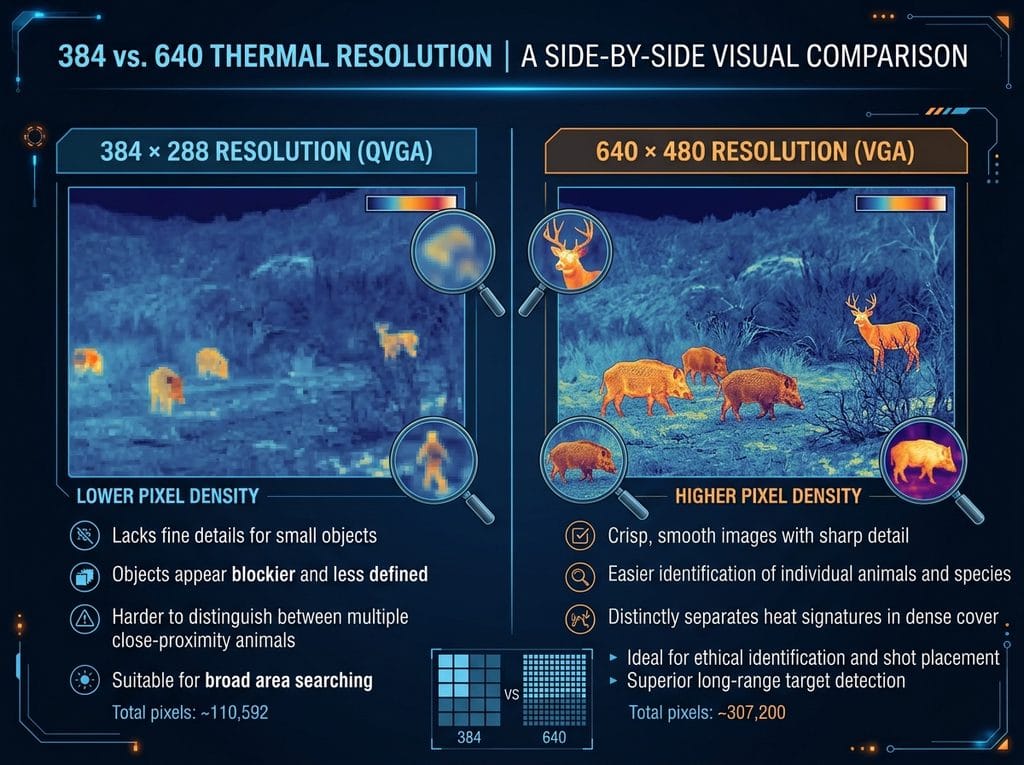
More samples across the target become particularly useful when the image is enlarged digitally. Digital zoom is effectively cropping and enlarging the sensor image. Starting with more captured information generally leaves more usable detail after that crop. This is one of the clearest real-world gains hunters see when moving to 640.
Where 640 Helps Most
- Digital magnification: Higher starting resolution gives the processor more captured detail to work with before the image becomes visibly pixelated.
- Identification at distance: More resolved samples across an animal can help preserve shape and detail, especially when environmental contrast is good.
- Wide field of view plus usable detail: A 640 sensor can be paired with an optical system that provides a wider field while still retaining substantial scene information.
- Scanning and tracking: Higher scene detail can make it easier to interpret multiple animals or cluttered backgrounds.
Where 384 Still Makes Sense
384-class thermal optics remain highly effective because the rest of the system has improved. Modern products pair 384×288 sensors with 12 μm or 17 μm pixel pitch, better sensitivity, fast f/1.0-class objectives, high-resolution OLED or AMOLED displays, and stronger image-processing algorithms.
For hunters operating at moderate distances, especially on known properties with defined lanes or feeder setups, a well-designed 384-class optic can deliver all the detail needed without the cost of a 640-class system. It can also allow a buyer to spend more of the budget on an integrated rangefinder, better mount, spare batteries, or a separate thermal scanner.
Field of View and Magnification Can Matter More Than Resolution
A 640 scope with too much native magnification for your property can be frustrating. High base magnification narrows the field of view and makes it harder to pick up moving animals at close range. A lower-magnification 384 optic may be much faster in thick cover or smaller fields.
Compare two current examples. Pulsar’s Thermion 2 XQ50 Pro uses a 384×288 sensor and 3× base magnification with a 7.5-degree horizontal field of view. The Thermion 2 LRF XP50 Pro uses a 640×480 sensor, 2× base magnification, and a 12.4-degree horizontal field of view. The second system combines higher resolution with a wider view, but that result comes from the complete optical design, not resolution alone.
Pixel Pitch Changes the Comparison
Pixel pitch describes the center-to-center spacing of detector elements, usually expressed in micrometers. Smaller pitch can support a more compact optical system for a given field of view, but it is not a stand-alone image-quality score. Sensitivity, optics, detector design, and processing still matter.
This is why it is better to compare complete specifications rather than treating “640” as one standardized experience. A 640×480, 17 μm system and a 640×512, 12 μm system can require different lens designs and can deliver different fields of view and magnification.
NETD and Lens Speed Matter in Low Contrast
NETD describes thermal sensitivity: how small a temperature difference the system can resolve relative to its noise. Lower values generally indicate better sensitivity. A fast objective lens also helps because it passes more infrared energy to the detector. Teledyne FLIR notes that f-number affects measured NETD and overall system performance.
When humidity is high or the animal and background are close in temperature, sensitivity and processing can become more important to perceived image quality than the jump from one resolution class to another.
Detection Is Not Identification
Higher resolution can help identification, but it does not turn a manufacturer’s detection-range figure into a practical shooting distance. Teledyne FLIR distinguishes detection, recognition, and identification as separate levels of task performance. Exact range depends on target size, atmospheric transmission, lens, sensor sensitivity, image processing, display, and observer performance.
Which Resolution Should You Buy?
| Your Situation | Better Starting Point | Why |
| Mostly close to medium range, budget matters | 384-class | Good current systems deliver strong performance without paying for pixels you may not use |
| Frequent digital zoom | 640-class | More captured detail remains after cropping/enlargement |
| Wide scanning field is critical | Compare FOV first | Resolution does not guarantee a wide field of view |
| Open-country identification at longer distance | 640-class | More resolved samples can help preserve target detail |
| Need LRF and accessories inside fixed budget | 384-class may offer better total system value | Budget can go toward rangefinding, power, mounting, and a handheld scanner |
Bottom Line
Moving from 384 to 640 can produce a real improvement, especially in detail retention and digital magnification. But the smartest purchase still comes from matching the whole optical system to the hunt. A 384 scope with the right field of view, native magnification, sensitivity, and lens can outperform a poorly matched 640 scope for a specific property.
Treat resolution as one of the major specifications, not the final verdict.
Frequently Asked Questions
Recommended Articles
- Thermal Optics for Hog Hunting in 2026: How to Choose the Right Thermal Riflescope
- Best Thermal Scopes Under $3,000
- What NETD Means on a Thermal Scope
- How Thermal Detection Range Differs from Identification Range
- How to Choose Thermal Scope Magnification and Field of View