Overview
Is thermal or night vision better for hog hunting?
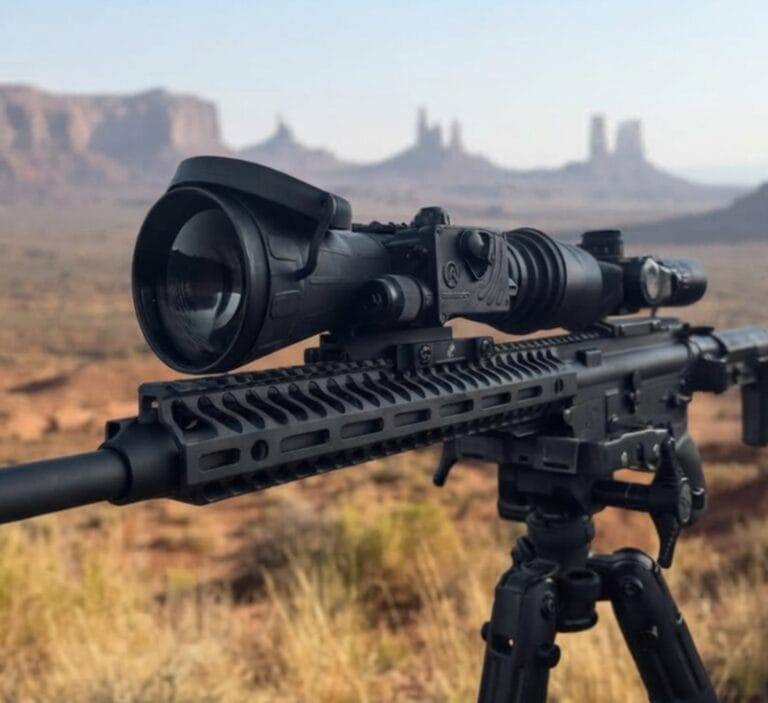
Thermal imaging is generally better for detecting hogs at night because it detects differences in infrared radiation without needing ambient visible light. Image-intensified night vision is often better for interpreting terrain, fences, vegetation, and other environmental details. Thermal is usually the stronger choice for locating animals, but neither technology eliminates the need for positive identification and a safe backstop. Taking everything into consideration, thermal will be the clear winner. From personal experience hunting hogs in Texas and Louisiana.
Understanding thermal imaging and night vision
Thermal imaging and night vision are frequently grouped together as nighttime optics, but they use different portions of the electromagnetic spectrum and produce fundamentally different images.
How thermal imaging works
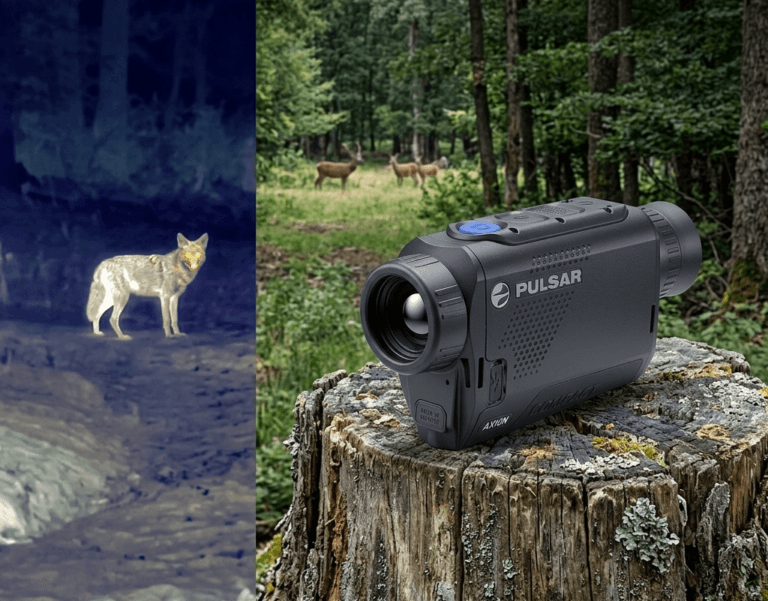
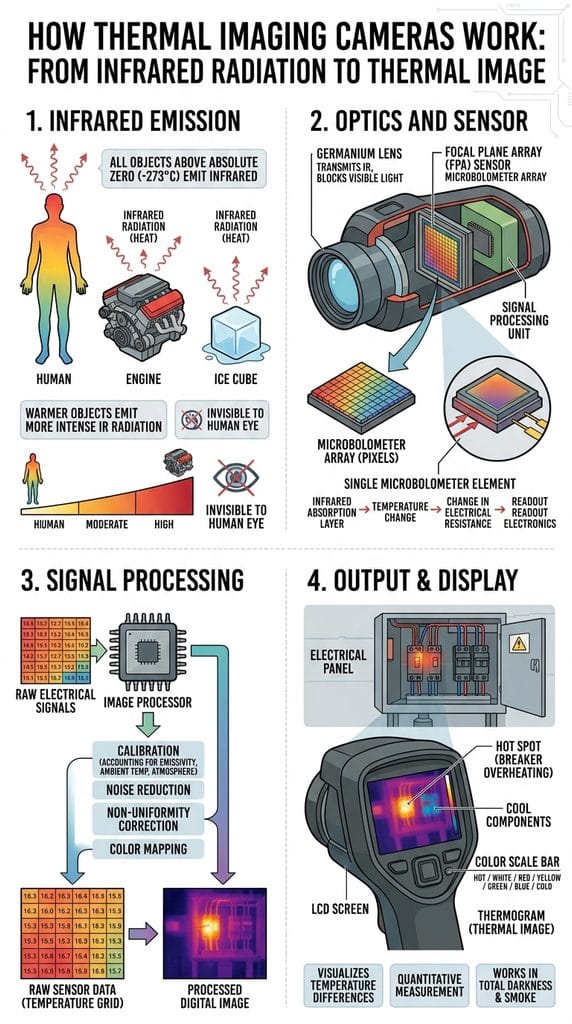
Thermal cameras detect infrared radiation emitted by objects and convert differences in detected energy into a visible image. Most uncooled thermal optics used by civilian hunters operate in the long-wave infrared spectrum.
Unlike conventional cameras, thermal imagers do not require reflected visible light to build an image. Their usefulness depends heavily on the temperature and emission characteristics of objects, atmospheric conditions, sensor performance, and the image-processing system.
For hog hunters, this technology offers a significant advantage when searching agricultural fields, pastureland, and woodland edges. An animal may be difficult to notice against dark vegetation using conventional imaging, yet stand out as a contrasting thermal signature. However, other animals, people, and objects can exhibit similar apparent heat signatures.
How image-intensified night vision works
Traditional image-intensified night vision collects available light from the environment and amplifies it electronically. An image intensifier tube converts incoming photons into electrons, multiplies those electrons, and produces a visible image using a phosphor screen. Familiar green and white-phosphor night vision displays are examples of this technology.
Rather than highlighting temperature differences, night vision preserves light-based environmental details. Trees, terrain contours, fences, buildings, and other objects often appear more familiar to the user. Image intensifiers require enough incoming light to produce a useful image; in extremely dark environments, supplemental near-infrared illumination may be necessary.
Important distinction: Digital night vision uses an electronic image sensor and display rather than an image-intensifier tube. Low-light sensitivity, latency, image quality, and dependence on IR illumination vary significantly by device.
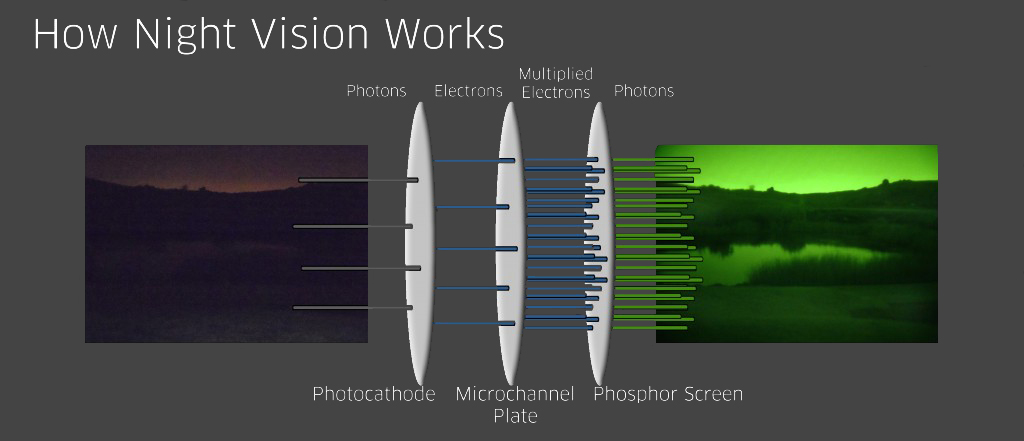
Source: U.S. Army PEO Soldier: Image Intensifier Tube
Source: FLIR: How Thermal Cameras Work
Why Thermal Is So Effective for Finding Hogs
Warm animals can stand out strongly against cooler ground and vegetation, especially when environmental conditions produce useful thermal contrast. That makes thermal a fast detection tool. A hunter scanning a field does not need to interpret a natural-looking scene first; the heat signature itself draws attention.
This advantage is strongest when the task is simply finding animals. The industry standard term is “DRI” which stands for Detection, Recognition and Identification. Knowing what a spec sheet says often times doesn’t provide the full picture. Most brands state the best spec which is “Detection”. On paper it gives the potential end user, an impressive number. Although the spec is accurate, it provides a false sense of expected performance by the end user.
Most end users realize once they use a thermal device while hunting. The reality versus expectations, vastly differs between how far they can detect an animal and being able to recognize or even identify what that animal is. In order to take an ethical shot while hunting. Knowing the “DRI” of the device you are using will help you distinguish between what is detection from recognition and identification. Detecting that something is present requires less visual information than correctly recognizing or identifying it. Thermal excels at that first step when contrast is favorable.
Thermal vs. night vision: Side-by-side comparison
| Feature | Thermal imaging | Image-intensified night vision |
| Animal detection | Typically excellent with favorable thermal contrast | Depends on illumination and visual contrast |
| Complete darkness | Operates without visible light | May require supplemental IR light |
| Recognizing terrain | Less natural scene representation | Often clearer environmental context |
| Animals near vegetation | Can reveal exposed heat signatures | Relies on visible/reflected-light detail |
| Seeing through brush | Cannot see through solid obstructions | Cannot see through solid obstructions |
| Viewing through glass | Ordinary window glass generally blocks useful LWIR transmission | Generally possible depending on lighting |
| Dense fog and rain | Performance can deteriorate significantly | Also degraded by weather and reduced visibility |
| IR illuminator | Not required | Sometimes needed |
| Primary advantage | Finding animals | Understanding the scene |
Why thermal imaging is effective for detecting hogs
Thermal imaging is particularly valuable when animals are difficult to distinguish from the background using conventional optics. In many hunting environments, wild hogs move through dark vegetation or along transitions between wooded cover and open fields. Thermal imaging can highlight their exposed bodies without depending on moonlight. However, the degree of contrast changes with environmental conditions.
Temperature contrast determines practical visibility
Thermal performance is not simply a matter of how hot an animal is. What matters is the apparent infrared contrast between the subject and its surroundings. A hog standing against relatively cool grass may be easy to distinguish, while the same animal against sun-warmed rocks or pavement may be more difficult to interpret.
After sunset, the ground and vegetation cool at different rates. Thermal contrast may improve or deteriorate as the night progresses. High humidity, precipitation, atmospheric absorption, and changes in background temperature can also reduce useful image quality.
Thermal imaging does not see through dense vegetation
Thermal optics may reveal exposed portions of an animal through gaps in leaves or light vegetation. They cannot reliably image an animal hidden behind a solid tree trunk, thick brush, or an opaque obstruction. Claims that thermal optics can see through forests or barriers are misleading.
Detection vs. Recognition vs. Identification
A thermal optic’s advertised detection range should not be confused with the distance at which a hunter can confidently identify a hog.
- Detection: Recognizing that an object or possible heat signature is present.
- Recognition: Determining its general category, such as an animal rather than an inanimate object.
- Identification: Obtaining enough information to confidently determine what the subject actually is.
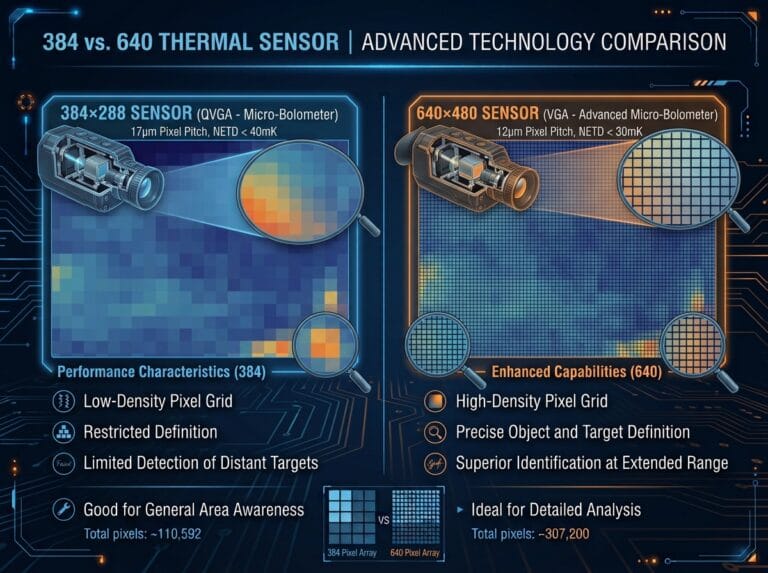
A thermal device may detect a distant heat signature long before it provides enough image detail for confident identification. Sensor resolution, native optical magnification, lens design, thermal sensitivity, focus, processing algorithms, and atmospheric conditions all affect usable detail. Digital zoom enlarges an image but does not create the same scene information as a higher-resolution sensor.
Where night vision provides an advantage
Terrain awareness and environmental context
Because image-intensified night vision relies on reflected light, recognizable environmental features can be easier to interpret. A user moving across uneven ground may find it easier to distinguish trail boundaries, branches, fences, and changes in surface texture. This is useful around agricultural equipment, gates, livestock enclosures, and wooded trails.
Observing animal characteristics
Under favorable illumination, night vision can preserve appearance-based information, such as body contours, surface markings, movement characteristics, and surrounding objects. Neither night vision nor thermal automatically provides positive identification at long distances.
Limitations of IR illuminators
Infrared illuminators improve compatible night vision in very dark conditions but introduce battery consumption, beam coverage considerations, reflections from nearby vegetation, and potential visibility to other IR-sensitive systems. Some animals may respond to illuminators, especially those producing a visible glow; responses are not uniform.
Weather, humidity, and environmental limitations
Neither technology is immune to difficult atmospheric conditions. Thermal performance can suffer when rain, fog, moisture, and atmospheric absorption limit infrared energy reaching the sensor. Night vision also loses usable detail when precipitation, fog, or poor illumination interfere with light reaching the device. Advertised performance in favorable conditions should not be mistaken for guaranteed field performance.
Choosing between thermal and night vision for different situations
| Hunting environment | Suitable starting point | Reason |
| Large open agricultural fields | Thermal | Efficient detection of exposed warm animals |
| Woodland edges | Thermal for scanning; night vision for context | Heat-signature awareness and environmental detail |
| Unfamiliar terrain | Night vision | Recognizable landscape and obstacle information |
| Complete darkness | Thermal | No ambient-light requirement |
| Livestock or multiple species nearby | Careful identification with either | Neither guarantees species identification |
| Dense fog or heavy rain | Neither is consistently reliable | Atmospheric conditions degrade both |
What to consider before buying thermal or night vision
Sensor resolution and image processing: Higher native resolution can preserve more detail, but optics quality, sensitivity, focus, and processing matter.
Field of view: A wider view covers more scene area; a narrower view presents less area at greater apparent detail.
Thermal sensitivity: NETD (noise-equivalent temperature difference) describes the detector’s sensitivity to small temperature differences under defined conditions. Lower is generally favorable, but manufacturers’ values may not be directly comparable.
Battery life and ergonomics: Consider weight, temperature tolerance, control accessibility, battery management, and comfort over long observation periods.
Purpose-built equipment: Observation devices and weapon-mounted optics serve different roles; choose equipment designed, rated, and legally permitted for its intended purpose.
Overall cost: Include batteries, charging equipment, accessories, warranty, and support when comparing value.
Common mistakes buyers should avoid
The most consequential mistake is treating advertised detection distance as a guarantee of positive animal identification. Other frequent errors include assuming thermal can see through solid objects, expecting every night vision system to work without light, buying solely by digital zoom, and confusing digital night vision with image-intensifier technology.
Avoid judging performance from a single promotional video. Display settings, weather, distance, recording compression, and image-processing enhancement can substantially change apparent image quality.
Safety and Legal Considerations
Night time hunting regulations differ by jurisdiction and may govern species, seasons, property boundaries, artificial illumination, thermal optics, night vision, and equipment. Verify current rules and landowner permissions before using night time technology. Thermal can make a warm subject visible without providing enough information to establish its identity. Positive identification, awareness of other people and animals, and a known safe backstop remain essential. No optic substitutes for verifying the target and what lies beyond it
Final Verdict: Which technology should you choose?
For locating hogs in darkness, thermal imaging generally provides the more useful starting point because it highlights infrared contrast without requiring ambient visible light. Image-intensified night vision is valuable when recognizing terrain, understanding surroundings, and interpreting light-based scene detail matter more.
Hunters who need both may benefit from complementary observation tools. The best purchase depends on law, budget, terrain, experience, and each device’s actual role, not simply its highest advertised specification.
Frequently asked questions:
Thermal vs. night vision for hog hunting
Recommended Articles
- Thermal Optics for Hog Hunting in 2026
- How Thermal Detection Range Differs from Identification Range
- 384 vs. 640 Thermal Resolution: What Hunters Actually Gain
- Thermal Optics for Predator and Coyote Hunting
- Best Thermal Scopes Under $3,000