Overview: What is the best magnification for a thermal scope?
Start with typical observation distance and terrain, not the largest advertised zoom. Lower base magnification generally provides a wider field of view for searching close cover and following movement. Higher base magnification makes distant subjects look larger, but narrows the scene. Sensor resolution, focal length, pixel pitch, and optics determine the available detail; digital zoom only enlarges existing image.
Start with the property – not the magnification number
A thermal scope is an imaging system rather than simply a night time version of a daytime rifle scope. When choosing one, first identify the work it must perform: broad area observation in woodland, monitoring the edge of a medium sized pasture, or studying distant activity across an open field. These environments demand different balances between scene coverage and target size. A narrow viewing window may feel impressive when an animal is centered, but can make acquiring a moving subject or maintaining context much harder.
Consider both your normal distance and your nearest likely encounter. A device selected entirely for the longest edge of the property can be frustrating when most activity occurs much closer. Published detection range is not equivalent to confident species identification, and neither figure alone defines a safe or appropriate engagement distance.
Base optical magnification vs. digital zoom
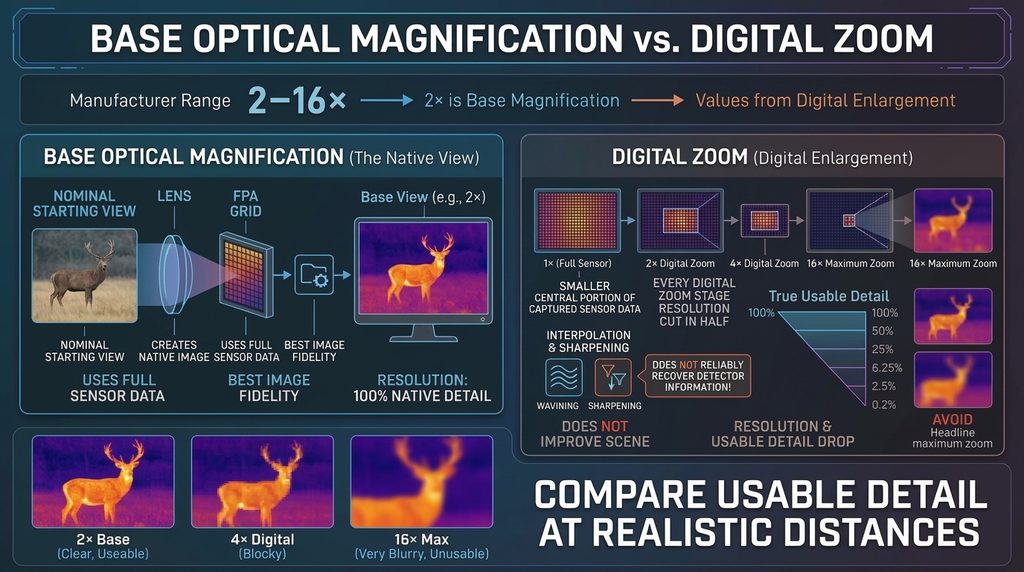
Base magnification is the nominal starting view created by the lens/sensor/display system. Thermal manufacturers commonly list a range such as 2–16×: the first value describes the base view, while higher values frequently arise from digital enlargement. Unlike an optical zoom lens, digital zoom does not improve the scene or rather enhance the size of the target.
At 2× digital enlargement, the displayed image usually uses a smaller central portion of the captured sensor data. At 4×, still fewer original pixels represent the visible field. Interpolation and sharpening can smooth edges or improve apparent contrast but do not reliably recover information that the detector never captured. In other words, every time an image is digitally enlarged the image resolution is cut in half. Therefore, compare native base magnification and usable detail at realistic distances before considering headline maximum zoom.
What field of view means in practice
Field of view (FOV) describes the angular or linear width of the scene visible at once. It is often expressed in horizontal degrees, or feet/meters at 100 yards/meters. A wider field offers better context, easier scanning, and less searching to keep movement within view. A narrower field can allocate more source pixels to a distant subject, but limits peripheral information.
The physical width visible at distance D is approximately 2 × D × tan(horizontal FOV / 2). This geometric relationship describes the scene width, not identification capability. For instance, a 12.4° horizontal FOV spans approximately 65 feet at 100 yards, while a 7.5° FOV spans approximately 39 feet at 100 yards (rounded). Those dimensions widen in proportion to distance.
How focal length, pixel pitch and sensor size interact
Focal length affects how much angular scene reaches the sensor: with a fixed sensor format and pixel pitch, a longer focal length typically provides a narrower field and larger target image. But focal length cannot be assessed in isolation. A physically wider detector can preserve broad field coverage even behind a long lens. Pixel pitch and pixel count determine detector width, while lens quality, aperture, alignment, focus, and software influence actual detail.
That is why two thermal scopes advertised with a 50 mm lens may have quite different field-of-view and base-magnification specifications. Lens focal length is not the same as the external objective housing diameter or a guarantee of identification distance.
Verified example: two Pulsar Thermion configurations
Manufacturer specifications illustrate the system-level trade-off without assuming either product is universally better. The Thermion 2 XQ50 Pro specification lists a 384 × 288 detector, 50 mm lens, 3× base magnification and 7.5° horizontal FOV. The Thermion 2 LRF XP50 Pro lists a 640 × 480 detector, 50 mm lens, 2× base magnification and 12.4° horizontal FOV. Both have a nominal 50 mm focal length, yet their scene coverage differs substantially because the detector format differs.
| Example model | Sensor | Base view | Horizontal FOV |
| Thermion 2 XQ50 Pro | 384 × 288 | 3× | 7.5° |
| Thermion 2 LRF XP50 Pro | 640 × 480 | 2× | 12.4° |
Specifications checked against Pulsar manufacturer manuals; these are illustrative configurations, not a ranking or claims of field testing. Product generations and regional configurations should be confirmed before purchase.
Source: Pulsar, Thermion 2 XQ50 Pro official specifications
Source: Pulsar, Thermion 2 LRF XP50 Pro official specifications
Practical starting points by terrain
| Primary setting | Illustrative base magnification | Main trade-off |
| Woodland, short clearings, small fields | About 1×–2.5× | Prioritize broad context and acquisition |
| Mixed pasture and brush | About 2×–3.5× | Balance coverage with useful subject scale |
| Open crop fields and long pastures | About 3×–4× or more | Greater distant scale with narrower view |
| Long-range observation only | Application dependent | Verify usable detail, not detection claims |
These are editorial screening ranges, not manufacturer performance ratings or universal prescriptions. A 640-class optic and a 384-class optic at the same nominal magnification may present very different scene detail and FOV. When comparing products, rely on actual angular field-of-view specifications.
384 vs. 640 resolution: what changes?
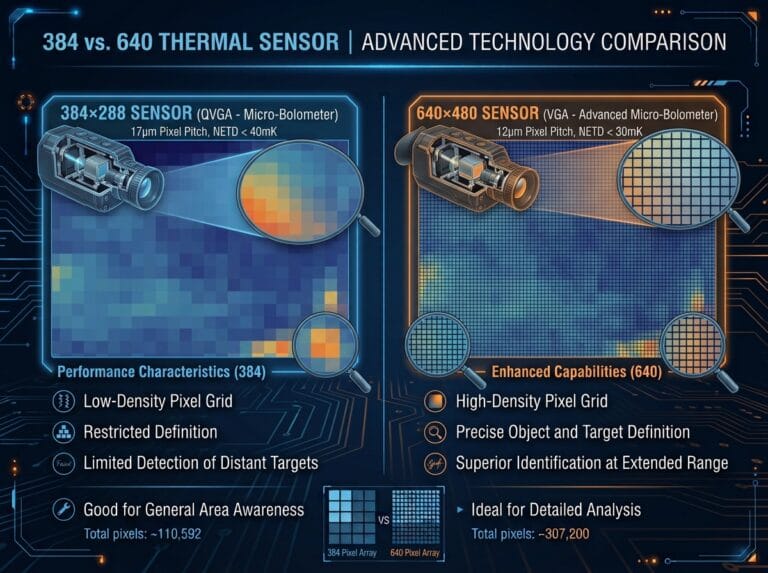
A common 384 × 288 sensor captures 110,592 temperature samples per frame; a 640 × 480 sensor captures 307,200. That is about 2.78 times as many detector pixels, not automatically 2.78 times more detection range. More samples may support a broader starting scene while preserving detail, or more cropping before pixelation becomes pronounced. The real result depends on focal length, optics, detector sensitivity, processing and atmospheric conditions.
When evaluating a 384-class optic, avoid assuming the lower count makes it unsuitable. A well-matched 384 system can be valuable at modest distances and within a narrower field. Likewise, 640 resolution alone cannot compensate for poor focus, weak thermal contrast, or an unsuitable lens.
NETD, focus, refresh rate and display quality
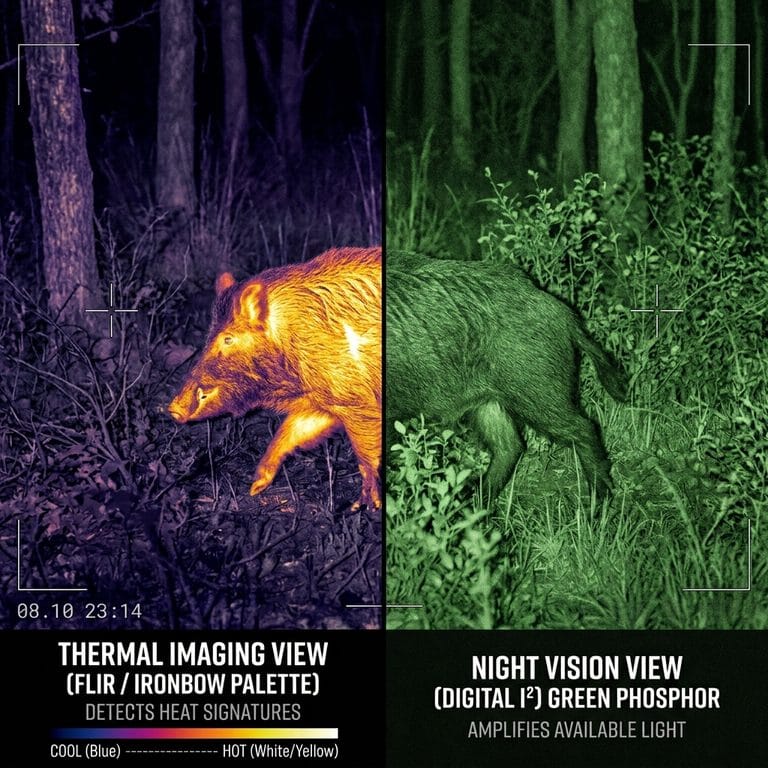
NETD (noise-equivalent temperature difference) is a detector/system noise measure often expressed in millikelvins. Under comparable test conditions, a lower NETD can support clearer low-contrast distinctions, but NETD values quoted under different conditions are not necessarily directly comparable. Focus is equally important: an unfocused image wastes sensor detail. Refresh rate affects perceived fluidity of motion, and display resolution affects how well captured data are presented to the eye; a higher resolution display does not create new sensor samples.
How to compare two thermal scopes before buying
- Define the property and typical viewing distances, including the closest areas.
- Compare horizontal field of view in degrees or width at the same distance.
- Check native/base magnification rather than maximum digital zoom.
- Compare sensor dimensions, pixel pitch, focal length and lens aperture together.
- Look for realistic demonstrations showing comparable distance, weather and image settings.
- Consider focus controls, battery endurance, comfort, warranty and available support.
- Confirm rules applicable to the location and intended use; prioritize positive identification and awareness of surroundings.
Source: Teledyne FLIR OEM, Choosing the Right Thermal Imager
Common misconceptions
More zoom always means a better thermal scope. A narrower view can make locating and following movement harder.
A 50 mm thermal lens tells the whole story. Sensor size and pitch also influence angular field of view and target sampling.
Digital zoom improves native resolution. Cropping enlarges existing data but does not create new detector information.
Detection range tells me identification range. Seeing a heat signature is not the same as confidently identifying its source.
640 resolution guarantees better performance. Optical quality, thermal contrast, FOV, processing and observer conditions also matter.
Conclusion
The most suitable thermal scope is the one that gives useful scene coverage and adequate detail at the distances you would use most. Start with terrain and field of view, choose appropriate native magnification, and then compare detector, lens, processing and practical usability. Maximum digital zoom is a secondary specification, not a shortcut to better imaging.
Frequently asked questions
How to Choose Thermal Scope Magnification and Field of View
Get the Best Gear Deals & Field Insights
Stay updated with top gear recommendations, reviews, and exclusive deals.